The preservation of western cultural and the American Cowboy. Sharing the history of the early trail drives, the Chuck Wagon and those who pioneered untamed land. The content is for educational and entertainment purposes. Cowboys and Chuck Wagon Cooking reviews cooking techniques, products and western gear which today is part of western life style. We hope you will enjoy your visit and look forward to comments, recipes and shared heritage. Thank you for your visit. Hope you follow us along the trail of news, stories and the Cowboy way.
United States Copyright 2009 - 2021 under title 17 of the U.S. Copyright Code.


Showing posts with label cowboy cooking. Show all posts

Sunday, September 1, 2013

CHEYENNE "The Daddy of them All"

 
Roger Edison - Reporting for Cowboys and Chuckwagon Cooking
Wyoming is well known for Cowboys and rich with history.  A mere 90 minutes north of Denver, Colorado is Cheyenne, the capital of Wyoming.  It's name brings forth the romantic images of the west; Cowboys, Rodeo, Railroads and majestic plains.  Since 1897, Cheyenne Frontier Days host one of the greatest Rodeo attractions often termed, "The Daddy of the all."   This year, 447 steers walked a three-mile course in unison from Hynds Boulevard into Frontier Park to await the forthcoming events.  Through the years, Cheyenne continues to draw over 200,000 tourist to experience the cowboy life and see the exciting shows.  Their slogan, "Cheyenne - Live the Legend."   
The legend begins long before the cowboys came to the frontier.  The Crow, Shoshone, Cheyenne and Lakota, were but a few of the original inhabitants that Anglo explorers first encountered.  John Colter, a member of the 1804 Lewis and Clark Expedition, was prohaps the first white American to enter the region in 1807. Colter, born in Virginia grew to become an avid hunter and mountain man.   French-Canadian trappers ventured into the Wyoming state in the late 18th century, leaving French toponyms such as Téton and La Ramie, though it would be  Colter that would map the area and report on what today is known as
John Colter, painting by Gerry Metz
Yellowstone National Park.  Colter as a guide for a newly form business, the Missouri Fur Trading Company  ventured on his own with pack and rifle.  It the spring of 1808, he return to Fort Raymond describing the thermal wonders of Yellowstone, though most were skeptical of his story and Yellowstone would be known as "Colter's Hell." Although while often believed Colter's stories to be myth, two expeditions and decades later, President Ulysses S. Grant signed the Act of Dedication law that created Yellowstone as a National Park, the first in the nation and the beginnings of what would later become the National Park Service.
 
The western frontier was attracting new migration of pioneers.  Earlier on the mountain men who operated fur trade came to the territory. By 1836, settlers and wagon freighters cross the area as an early route of the Oregon Trail.  Mormons began passing through Wyoming on their way to Utah and other pioneers followed seeking new lands, gold, silver and other opportunities. An estimate of 350,000 pioneers crossed the area from 1841 to 1860.  
Clashes between the new pioneers and Native American Indians, the US Government established Forts to protect the emigrants. Fort Laramie originally an outpost to protect fur traders would house 350 soldiers by 1849.  The need for beef to feed the Army and growing populations would motivate early trail drives to the area, though raising cattle locally would become profitable.
Seth Ward, a sutler to Fort Laramie, left cattle out to graze the open range in the winter of 1852-53 along Chugwater Creek north of what is now Cheyenne. He expected to find carcasses in the spring. Yet when he returned he found “the oxen,” as he called them, thriving.  
The region had acquired the name Wyoming by 1865, when Representative J. M. Ashley of Ohio introduced a bill to Congress to provide a "temporary government for the territory of Wyoming". The name Wyoming derives from the Munsee name xwé:wamənk, meaning "at the big river flat", but it was also named after the Wyoming Valley in Pennsylvania, made famous by the 1809 poem Gertrude of Wyoming by Thomas Campbell.  

 On Susquehanna's side, fair Wyoming! 
Although the wild-flower on thy ruin'd wall, 
And roofless homes, a sad remembrance bring, 
Of what thy gentle people did befall; 
Yet thou wert once the loveliest land of all 
That see the Atlantic wave their morn restore. 
Sweet land! may I thy lost delights recall, 
And paint thy Gertrude in her bowers of yore, 
Whose beauty was the love of Pennsylvania's shore!
After the Union Pacific Railroad had reached the town of Cheyenne in 1867, the region's population began to grow steadily, and the federal government established the Wyoming Territory on July 25, 1868.  
On December 10, 1869, territorial Governor John Allen Campbell extended the right to vote to women, making Wyoming the first territory and then U.S. state to grant suffrage to women. In addition, Wyoming was also a pioneer in welcoming women into politics. Women first served on juries in Wyoming (Laramie in 1870); Wyoming had the first female court bailiff Mary Atkinson, Laramie, in 1870); and the first female justice of the peace in the country Esther Hobart Morris, South Pass City, in 1870). Also, in 1924, Wyoming became the first state to elect a female governor, Nellie Tayloe Ross, who took office in January 1925. In fact, Wyoming and Texas both elected female governors at the same time, but Wyoming's took office sixteen days before Texas's.  Due to its civil-rights history, Wyoming's state nickname is "The Equality State", and the official state motto is "Equal Rights." 
Wyoming was the location of the Johnson County War of 1892, on which the controversial 1980 film Heaven's Gate was based, which erupted between competing groups of cattle ranchers. The passage of the federal Homestead Act led to an influx of small ranchers. A range war broke out when either or both of the groups chose violent conflict over commercial competition in the use of the public land. 
The Daddy of them all - The Cheyenne Frontier Days has received the Professional Rodeo Cowboys Association (PRCA) Large Outdoor Rodeo of the Year award for the fourteenth time at a National Finals Rodeo award banquet held in Las Vegas, Nevada. 
 The Air Force performs their annual air show where the Thunderbird's share a long history with Cheyenne Frontier Days.  In 1947, while the jet age was still in its infancy, military aviation was hurtled into the future with the creation of the U.S. Air Force as a separate service.  Just six years later, on May 25, 1953, the Air Force’s official air demonstration team, designated the 3600th Air Demonstration Unit, was activated at Luke Air Force Base, Ariz. The unit adopted the name “Thunderbirds,” influenced in part by the strong Native American culture and folklore from the southwestern United States where Luke Air Force Base is located.  That same year, they made the first public appearance at the Cheyenne Frontier Days. 
Air Force Thunderbirds
In 1989, our nation lost a great bullrider on July 30 at the Cheyenne Frontier Days Rodeo. Lane Frost after completing a successful 91-point ride on a Brahma bull named "Taking Care of Business", dismounted and landed in the dirt. The bull turned and hit him in the side with his horn, breaking several of Frost's ribs. Lane initially rose to his feet and yelling at Tuff Hedeman for help. As he was running and signaling for help, Frost fell to the ground causing the broken ribs to puncture his lungs and heart. Lane was rushed to Memorial Hospital where he passed on. 
Free pancake breakfast held Monday, Wednesday, and Friday with nearly 40,000 people taking advantage of this every year, volunteers serve over 100,000 pancakes along with 3,000 pounds of ham that is sponsored by the local Kiwanis chapter. 
The rodeo action is powerful in Cheyenne.  Taylor Price won the Bareback Bronc with a scoring ride of 86 points.  Wade Sundell who had a serious injury to his left foot last year scored a 90 point ride on the third go around winning the Saddle Bronc event.  Will Scaffer would be this year Rookie having two great rides.
Dru Melvin with a 5.9 second score on the first go around of Steer Wrestling along with contestants Bray Armes and Matt Mousseau both had great times in the first go around but could not maintain a winning average in the second and third run finding Pampa, Texas born Matt Reeves winning the event.  
Mike Chase lasso over Bobby Harris and Trevor Brazile winning the Steer Roping event while contestants in the Senior Steer Roping found all but one performance having no time allowing Bobby Harris to easily win having three successful scores.  
Teague, Texas cowboy Scott Kormos entered the final round in eighth place and still did not believe he had any chance of a victory win in the Tie-Down Roping Event, even after his 12.4 seconds run in front of a giant crowd at the Frontier Park Arena. But combined with his other two runs, the veteran tie-down roper had a three head average of 39.5 seconds that held up and took first place by four-tenths of a second.   Jade Corkill from Fallon, Nevada partnered with Clay Tryan from Billings, Montana takes first with Team Roping.  
Christy Loflin
"In the sport of barrel racing we have so many variables that affect the outcome of our success. Sometimes things don't go our way and it's easy to lose sight of our dreams. Being positive and able to take the good with the bad has been the key to my success. I don't have any special talents or great barrel racing skills, I just always kept my dream in my heart and never, never, never gave up," states Christy Loflin who took second place last year at the Cheyenne Frontier Day's Rodeo. Her perseverance paid off winning First this year. 
Former Marine and rodeo performer, Wild Bill Williams who today is a football coach remembers a young skinny lad weighing 140 pounds and standing Five feet eight inches getting ready for high school rodeo. The left handed rider would go on to join the CBR, then entered the PBR earning Seven PBR World Finals Qualifications.  Today, that young cowboy is Cody Whitney from Asher, Oklahoma and an inspiration to the sport of Bull Riding winning the Cheyenne Frontier Days Rodeo with a purse of  $10918.93     
However, the best part of the Cheyenne Frontier Days might just rest with the chuckwagon cooks, who like rodeo contestants, come from all across the nation to compete.  One cook, Randy Brown discovered chuck wagon cooking by just tagging along where he became hooked after his weekend there. Before he left, he made arrangements to buy a wagon and took it back to his home in Pennsylvania. Along with the chuckwagon competitions, many youth show off their cooking skills working off the chuck wagons.  All part of living the legend.  
Read  Cheyenne Frontier Days 2013 Chuck Wagon Cook-Off   story by Cassandra Swanson
Cheyenne Frontier Day's Youth Chuck Wagon Cook-Off
 

Seth Ward, a sutler to Fort Laramie, left cattle out to graze the open range in the winter of 1852-53 along Chugwater Creek north of what is now Cheyenne. He expected to find carcasses in the spring. Yet when he returned he found “the oxen,” as he called them, thriving. - See more at: http://www.wyohistory.org/essays/wyoming-cattle-boom#sthash.4avxJ4M8.dpuf

Saturday, August 31, 2013

Cheyenne Frontier Days 2013 Chuck Wagon Cook Off


Story by Cassandra Swanson of Canton, SD

Wisps of steam swirled out the spout of the ever present coffee pot hanging over the coals as the cowboy passed out cups to early morning stragglers to sample the brew.  The sun just crested the trees and the golden glow lit up the dozen chuck wagon camps as the cooking crews drifted about…it was Cook Off Day at Cheyenne Frontier Days…and on this damp, cool morning, the heat was on. Literally.


Within five hours, the cooks would transform a standard issue of groceries into mouthwatering chicken fried steak, mashed potatoes, beans, biscuits, and cherry cobbler vying for bragging rights of winning the “grand-daddy of ‘em all” – and wearing that CFD Belt Buckle proudly home to one of the six states represented at the 2013 event.


In its 11th year, Cheyenne Frontier Days is one of the most coveted chuck wagon competitions to participate in.  Although chuck wagon and Dutch oven cooking have been around for over 100 years, competitions were sporadic, and there was not a home base for those interested in participating.  More than a dozen years ago, a small group of Old West enthusiasts and wagon masters talked about creating a chuck wagon association that would preserve the heritage of the chuck wagon and its use in the short, but significant, era of the cattle drives.  The ACWA (http://americanchuckwagon.org/) was born, and today, there are members in nearly every state, Canada, Germany and Switzerland.  Members participate in cook off competitions, demonstrations, catering, charity events, school visits and many other activities to fulfill that original mission and even surpass the dreams of those organizers.


Debbie Watson gets the credit for bringing a chuck wagon competition to CFD…and Debbie Russi has been assisting her in this monumental task for five years.  They are part of the incredible volunteer base of over 2500 individuals that bring CFD to life, as members of the 500+ strong, very busy, Parade Committee.  A dozen chuck wagons are invited to compete each year, and those wagons have the option of re-upping for the following year – if they choose not to, a waiting list exists of wagon owners who dream of an invitation to Cheyenne!


Cassandra and Steve Swanson (Canton, SD), Jim and Susan Patrick (Watertown, SD) photo credit Deb Russi
After years of creating and running my own chuck wagon events, I was invited to attend CFD and help cook on the South Dakota “DT” chuck wagon.  It was thrilling to meet the 2013 wagons -  included the Pampa, TX “Honey-Do Spoiler” wagon with Kevin Romine, Gerald Rasco, and Royce Henderson keeping the pots hot with the help of three delightful grandsons, Gatlin, Drake and Tate…This congenial crew kept the coffee on and invited us down for an incredible supper after an unexpected July hailstorm had us ALL running for cover!  Next in line was Jack Ramey’s “Crosstimber “ wagon from Mustang, OK.  Jack cooked with Todd and Heath Limke, and the fabulous ‘real’ American Icon of a cowboy, Eulan E. Peters – better known as just “Pete”.  Despite tossing a mean snow-, I mean HAIL-, ball at our camp, Dan MacCaffree and his “Musselshell” wagon cooked up some fine grub as well.  Dan and his wife, Carol, along with Chris and Julie Munson, hauled in from Round Up, Montana – my old stomping grounds!  We have had the privilege of being around Dan and Carol at several events these last few years, and a finer batch of folks has not been created.  Ned and Terry Larson hauled their “Creekhouse” chuck wagon from Stevensville, MT and cooked with Mike & Kathy Warren and Dennis & Julie Moffet…Frank and Georgianna Lipus were our closest neighbors with their “Gold Creek” wagon from Hamilton, MT.  They cooked with the hilarious Mario and Yvonne Torres whose name we could never keep straight.  We had the privilege of cooking on the Number ONE winning wagon at CFD – the Patrick’s “DT” wagon of Watertown, SD.  Jim and Susan compete and show their beautifully restored Peter Schuttler Wagon throughout the year.  Jim claims “DT” stands for Dakota Territory, but Susan insists it stands for Delerium Tremens – which is what all the wagon cooks suffer from during a cook off!  Go figure.  Donnie and Joe Daniels were our other ‘neighbors’ with their “Running D” wagon from Harrison, AR.  Donnie had an adorable short, two-man saw that Mr. Patrick was seriously in love with.  Brenda Thomas cooked at their camp with them.  The “(HO” owned by Cindy and Ray Gullion from Worland, WY was next in line, with Heidi Hernandez and Charlotte Brown assisting, and next to them was the 2012 Champions, the “Wishbone” wagon of Axtell, TX.  My two oldest sons, Clell and Caleb, had the honor of participating in the 2012 Kid’s cook off with this wagon, and Caleb won the meat
Jim Patrick  DT Chuck Wagon
championship, and wears his beautiful buckle constantly.  The Wishbone is owned by Brian and Sue Frankum, and they cook with the Soupbone Cattle Company, Butch and Sue Dohmann, also of TX.  Dr. T.C. Glenn of Arlington, TX owns the “Broken T” chuck wagon, and J. Aubry Lenamon from Victoria slung pots for them.  The “3LazyR” wagon owned by Fred and June Woods of Pine Bluffs, WY cooked with Beth and Kathy and the 2013 CFD Champions were the “Curly Cue” wagon owned by Clint Combs of Las Vegas, NV.  Clint’s sister, Tina Stallard, of Albuquerque, NM and her family cooked on the wagon and cleaned house in the food division.


Cheyenne Frontier Days is a week long chuck wagon cooking experience, with some amazing, historic rodeo fun thrown in for good measure.  It would not be CFD if you did not attend one of the fabulous parades held every other day, or the Pancake Feed offered a couple times a week – where else can you eat pancakes where the batter is mixed in a CEMENT MIXER truck and flipped off the griddle high thru the air by Rodeo Queens from across the country?  I have to thank the delightful gate guards who fitted me with a cowboy hat so that I could go behind the chutes daily to enjoy some close up rodeo action.  I will also hand it to CFD – no other city gets behind an event and supports it as thoroughly as Cheyenne believes in this rodeo week.  Every business and the majority of the community play a part in making this show work – especially since the approximately 60,000 population is inundated with over 500,000 visitors from around the world who trek to this historic town not only to see history, but to be a part of it.  CFD (http://www.cfdrodeo.com/home) should be on your bucket list…it truly is a once in a lifetime experience, but make your reservations early, the hotels book quickly.  While there, be sure to mosey by the chuck wagons and have a cup of cowboy joe…and if you are lucky enough – be there on sampling day – and you will know why chuck wagon cooking is more of a historical passion than a passing hobby.


Can’t leave you without a list of the 2013 winners:

The Youth contest was sponsored by John Brewster .  There were 14 young people competing:

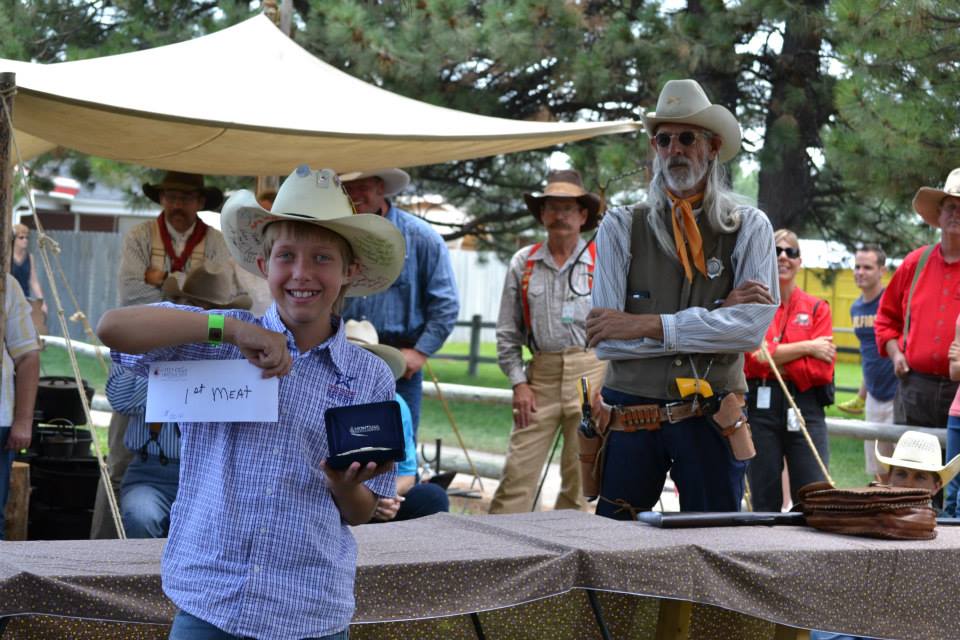
MEAT: 1st Thomas Watson cooking with Curly Cue, 2nd Jack Osborn cooking with Honey Do Spoiler, 3rd Dillon Robertson cooking with Quarter Circle HO

DESSERT: 1st Troy Larson cooking with 3 Lazy R, 2nd Montana Robertson cooking with Gold Creek, 3rd Jeff Yepson cooking with DT Chuck Wagon


There were 12 wagon competing at CFD. The wagon judges were John Brewster, Don Shephard and Ken Wallis.
MEAT: 1st Gold Creek, Frank & Georgianna Lipus, 2nd Curly Cue, Clint Combes, 3rd DT, Jim Patrick
BEANS: 1st Uncle Fred’s Catering, 2nd Lazy Double L, 3rd Curly Cue
POTATOES: 1st Honey Do Spoiler, Keven Romines, 2nd Curly Cue, 3rd Crosstimber, Jack Ramey
BREAD: 1st Musselshell, Dan & Carol McCaffree, 2nd Curly Cue, 3rd Quarter Circle HO, Ray & Cindy Gullion
DESSERT: 1st Creekhouse, Ned & Terri Larson, 2nd Wishbone/Soupbone, Brian & Susan Frankum & Butch Dohmann, 3rd Crosstimber
WAGON: 1st DT, 2nd Wishbone/Soupbone, 3rd Curly Cue
OVERALL: Curly Cue
See you July 18-27, 2014 at Cheyenne Frontier Days!
 
Jim Patrick and Steve Swanson chopping wood

photo credit Jim Patrick

Saturday, February 2, 2013

BRER RABBIT

Molasses has a long history before the cowboys drove the first herds of cattle of early Texas to New Orleans.  In 1857, Cowboy J. M. Cowley of Fentress, Texas stated, "We had to go to the Brazos River to buy corn for cornbread.  Beef, Cornbread, Molasses and Coffee was the principal diet in those days, and it was a wholesome diet."  Chuckwagon cooks enriched the many staples sweetening the taste using the thick rich syrup, molasses. 
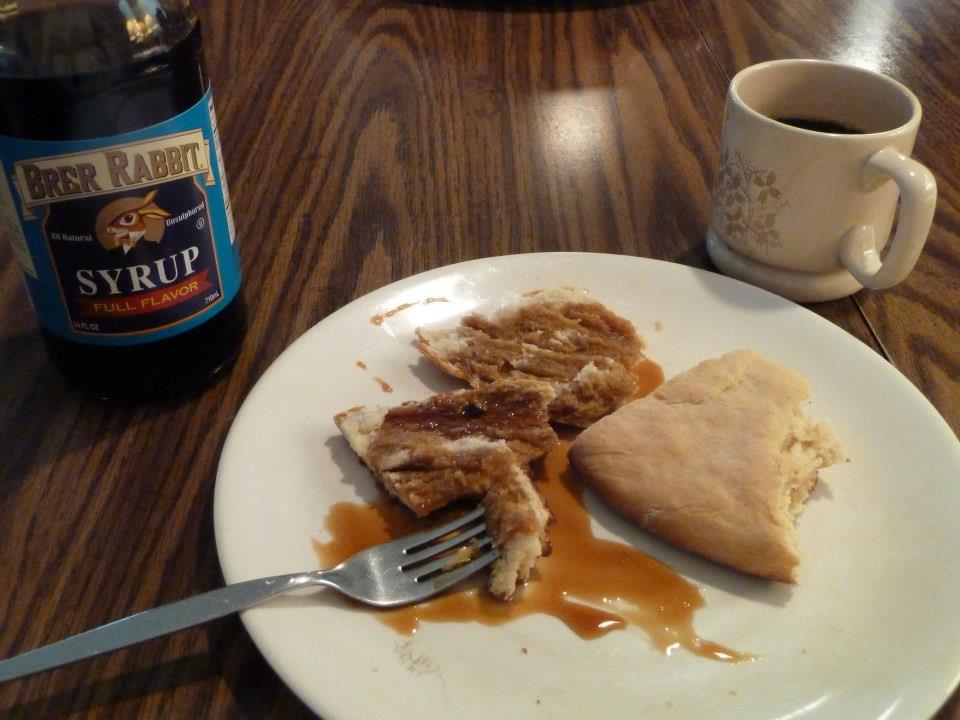
Brer Rabbit Molasses and Syrups today, continue to give that great taste for sweetening many recipes. Sometimes enjoyed  just by adding directly on waffles, pancakes and even one of my favorite breads, Pan De Campo.  Just as the chuckwagon cooks did years past on those cattle drive.   Brer Rabbit, much like the Cowboy has an interesting history in both American literature and as an emblem for a syrup business dating back a hundred years.   
Pan De Campo smothered in Brer Rabbit Syrup with Coffee photo Credit: Wayne Hanselka
The emblem Hare often a trickster succeeding by wits, though not always successful, are the efforts of Br'er Rabbit and the many stories making him a folk hero. The character used not only for the fine molasses and syrups, but also in many Disney movies and books, including the stories written down by Robert Roosevelt, uncle to President Theodore Roosevelt, publishing them in Harper's, where they fell flat. This was a good many years before a genius arose who, in 'Uncle Remus', made the stories immortal with the fictional Tar-Baby in the second of the Uncle Remus stories published in 1881 along with folklorist Alcée Fortier in southern Louisiana, where the Rabbit character was known as Compair Lapin in Creole French. Enid Blyton, an English writer of children's fiction, retold the stories along with the writings of Joel Chandler Harris, as well ethnologist for the Smithsonian Institute, John R. Swanton, who traces the origins of br'er Rabbit back to cultural heritage and stories of early Native American tribes of Creek Indians and Cherokees along with early enslave Africans. 
Br'er Rabbit and Tar Baby
Author, Jace Weaver, "That the People Might Live: Native American Literatures and Native American Community" traces the relationship further about the great hare, Br'er Rabbit which the stories originated mostly in Cherokee myths.  These stories past down around camp fires, heard my early Anglo settlers who migrated to North America from Europe and again past through the generation before becoming the great tales of the interesting Hare.
Today, the Brer Rabbit label continues sales through B&G Foods, Inc who purchased the name from Nabisco, Inc in 1997. Although the roots long begin before the 20th century with Penford Corporation of 1896 that moved to Harvey, Louisiana. The monopoly of Corn Products Refining Company (CPR) acquired 25 percent interest in Penick molasses and corn syrup trade.
However, in 1913, under Teddy Roosevelt’s trust busting campaign, the Supreme Court decision force CPR to divest its interest in Penick and Ford. This interest was bought by F.T. Bedford, the son of CPR’s E.T. Bedford in which the son had a falling out with his father desiring to be in business on his own. Instrumental while working with his father, F.T. Bedford was largely responsible for developing Karo and Mazola brands before forming his own business an created the Br'er Rabbit Label. An act of Teddy Roosevelt's trade busting, who's Uncle created such great stories of the witty Rabbit would only be appropriate to rebel against the former Syrup empire an once more, see the rabbit out smart the fox. 
I have to extend some thanks to Calvin Wayne Hanselka, who made that great Pan De Campo Breakfast smothered under the covering of Brer Rabbit "Full Flavor" Syrup and remembering the great tales from the Uncle Remus stories.
Pan De Campo Bread made in a Cast Iron Dutch Oven
 I was honored to meet Calvin "Wayne" Hanselka during the King ranch Hand Breakfast while I was working on the chuckwagon making the fabulous bread that Cowboys enjoyed during the days of the trail drives.  It became the official "Bread of Texas" in 200 .   Here's the RECIPE  for making Pan De Campo.
Cowboy Cook Roger Edison, (left)  with Dr. Hanselka, PhD Texas A&M (standing right) at King Ranch in 2012.  Dr. Hanselka specialized in Ranch Management, Natural Resource, and Cultural Resource Management information.  He conducted Consulting, teaching, planning and active management for land managers in both the United States and Mexico.  
BRER RABBIT ADVERTISEMENT 1948


The word, "Molasses" comes from the Portuguese word, (melaco), which derived from the latin word, (Mel) meaning honey.   Molasses in made through refining sugarcane, though is also made from Grapes in many countries of the Middle East and also from Sugar Beets.  Although Sweet Sorghum, often marketed as molasses in not a true molasses.  
When Columbus discovered what would become the Americas, he brought with him sugarcane to the new world. Although, Sugarcane originates in New Guinea where it has been known since around 6000 BC.  It's cultivation gradually spread into migration routes reaching Southeast Asia, India and the South Pacific about 1000 BC.  
Arab trade routes into Asia, would further spread the crop into Egypt during the Arab conquest of 640 AD.  As they advanced further into areas of the Mediterranean, the sugan cane would continue to spread eventually into Syria, Cyprus, Crete and reaching Spain around 715 AD.  
The trade of sugar cane would be introduce to Madeira and soon reaching the the Azores, West Africa and the Canary Islands around 1420.  As Columbus began his first explorations to the New World, he would take sugar cane from the Canary Islands where he resupplied the Gulf of Arrows which he named such due to meeting the only hostile Indians during his first of four voyages which present violent resistance and use of arrows by the Ciguayos Indians. Today, the location called the Bay of Rincon in Samana, Dominican Republic.  By 1520, Spanish explorations would spread the crop to both central and South America eventually reaching north America through Bristish and French trade.
To make molasses, harvested sugar cane is stripped from its leaves, then cut, crushed and mashed to extract the juices from the plant. The juice is boiled into a concentrate which promotes the crystallization of sugar. This molasses has the highest amount of sugar content due to little amounts of sugar has been removed.  The second boiling again removes more sugar though crystallizing and has a bitter tinge to its taste.  Upon the third boiling, this yields the finest syrup called "Blackstrap" Molasses.  A term that is solely Americanism dating just after the turn of the 20th century. 
Since the majority of sucrose has been removed from the original first two boilings, Blackstrap Molasses today is often marketed for its high energy and sold as a health supplement having a great source of calcium, magnesium, iron and potassium in addition to traces amounts of vitamins and other minerals. One tablespoon per day provides 20 percent of the daily value of those nutrients.  
Molasses is also used for making Rum, ethyl alcohol, cattle feed supplements, dark beers such as Stout and Porters. It is also through chemistry mixed with various chemical agents for de-icing, rust removal and as an alternative fuel source for automobiles.  
Although, I enjoy using molasses when cooking from baking needs to BBQ rubs.  I often even use it to make Brown Sugar which is combining  1 cup of granulated cane sugar to 1 tablespoon of  molasses.  Simple mix in a bowl using a wood spoon until completely blended, then store in an air tight container. It yields one cup and if you desire an even darker, richer brown sugar, add an additional tablespoon of the molassesYou will enjoy the many different recipes which molasses will truly enhance and Brer Rabbit is a name that has been with us nearly a hundred years.

Sunday, March 18, 2012

"Cowboys for Heroes" Chuckwagons aid Fort Sam Houston

Cowboys for Heroes
Story by Roger Edison


The Chuck wagons are making ready for the 7th annual "Cowboys for Heroes" as they roll into San Antonio, Texas to support and honor the wounded warriors on Saturday, March 31, from 11 a.m. to 5 p.m. at Fort Sam Houston Equestrian Center. There will be Charro demonstrations, Mutton busting, western entertainment, live music, along with great food provided by the Chuckwagon cooks that will be firing up their spits over the open fires feeding the wounded warriors of our American Armed Forces, their family members and patrons of the (MWR) Morale, Welfare and Recreation program for members of the Armed Forces.  

Colloquially known as "Fort Sam," it is named for the first President of the Republic of Texas,   Sam Houston.   The fort was founded in 1876 when construction finally began, though the U.S. Army attempted to secure an establishment of a permanent installation occupying the Alamo as early as 1846.  During the Mexican-America War the United States Army established a quartermaster depot at San Antonio and a training camp at San Pedro Springs.  By 1849 San Antonio was named headquarters of the United States Army Eighth Military District. At the end of World War II, the Army decided to make Fort Sam Houston the principal medical training facility.  Military Medical Training is provided by numerous elements,  including METC, AMEDD Center and School, Brooke Army Medical Center, US Army Institute of Surgical Research, The Center for Battlefield Health and Trauma, Defense Medical Readiness Training Institute, as well as many smaller organizations.  In 2011, The US Navy and Air Force medical training departments also alined joining with the US Army training under one roof.  Fort Sam Houston is the Army's largest and most important Military Medical post in the world. 

Charro Performances include internationally known Gerardo 'Jerry' Diaz.  A fourth generation charro who continues traditions that originated with his great grandfather over 150 years ago. Jerry, who makes his home in New Braunfels, Texas, operates Three Mile Creek Ranch, a 50-acre horse operation in addition to performing his horsemanship skills.  The Charro is different from Vaqueros, Ranchero , Cowboys and Rancher from their etiquette, mannerism, clothing, tradition and social status.  The traditional Charro is known for their colorful clothing and participating in coleadero y charreada, a specific type of Mexican rodeo. 

Aubrey Lenamon, with Chuck Wagons for Christ, is the event coordinator assisting  putting together this event "Cowboys for Heroes."   In their seventh year, he recruits approximately ten chuckwagons from across the nation to support in the wounded warrior project.  Additionally, each year, needing to raise around $20,000 to fund the non-profit event,  Aubrey reallies on sponsors willing to give back to those who have made such a huge sacrifice for our nation and our freedoms.  

Aubrey,  who goes by Arb for short,  spent his life working in the oil fields.  When most are retiring to golf or fishing,  Arb's life fell to pieces.  His marriage of 35 years came to a sudden end along with his career. If that wasn't enough, his health turn finding him at the doctors office more frequently.  Although, Arb wasn't giving up. He turned towards his life passions which changed his life.  Arb has always had a strong faith in God, loved being a cowboy and a strong patriot.  When many men are put to pasture in their late fifties, Arb put his passions to work heading up the non-profit support ministry called Chuck Wagons For Christ to promote the cowboy culture while serving the Lord.  
Aubrey Lenamon, with Chuck Wagons for Christ
Interviewed last year by military journalist Minnie Jones, Arb commented, "It was very humbling to have the opportunity to talk with those in recovery and see what the horrors of war can do to a person. I am amazed at the positive attitudes, they (the wounded warriors) have. I talked to one young lady who had lost a leg. She had such a great attitude that it brought tears to my eyes. She wasn't letting a thing like that slow her down. That young lady is going to do well in life. That's a testimony of what great work the Army and MWR are doing here at Fort Sam." 

DEEP FORK CATTLE COMPANY  are among the many Chuckwagons joining Arb to assist "Cowboys for Heroes." Owned and operated by David and Sherry Roberts, they reside in Chandler, Oklahoma who have made this trip several times and also assist Cowboy ministries.  Last year they were assisted by James and Donna Martin who worked as part of the DEEP FORK CATTLE COMPANY chuck wagon crew. David and Sherry travel with their wagon competing in Texas, New Mexico, Kansas, Missouri and Oklahoma.

4 BUCKS CHUCK WAGON of Lavernia, Texas is owned and operated by Chris and Cody Buck. Their chuckwagon manufactured by the Weber Wagon Company is well over 100 years old. Chris does custom leather work from western horse tack to fashion, guns cases or rodeo chaps. They also cater in the south and central Texas area often assisted by good friends Mark Voigt, Jim Bob Fleming and Tucker Fleming.

THE WISHBONE WAGON owned by Brian and Susan Frankum from Axtell, Texas have provided authentic chuckwagon catering for numerous years while also assisting mix of Cowboy ministries. Last year, the Frankum's were assisted by Bubba, Sabrina and Chelsie Carter as part of their chuckwagon crew. Susan states, the WISHBONE provides and unforgettable experience along with unforgettable taste. 

THE GOODE RANCH are husband and wife team Buster and Diane McSparran of Hamilton, Texas.  Buster states, "Chuck wagon people gather for many reasons, both social and informational. They swap stories and recipes. They mentor the newbies while admiring one another's wagon accoutrements. It's like going to a family reunion where you like all your relatives." 

THE ROCKIN 12+  owned by Nick Ploch of New Braunfels, Texas and assisted by his crew, Pinky Eiesman, David Snyder, and Kelvin Kramm.  Nick's grandfather operated a long time dairy farm operation called the Rockin 12, so when Nick began operating his Mitchell Wagon as a chuckwagon, he added the Plus sign to the brand. While the Rockin 12 Plus crew rarely takes the wagon outside of Texas and cook mostly for fun, they are some superb cowboy cooks that recently won first place in the Meat category at the Cowboy Country Round-Up held last February in Hondo, Texas. 

OUT YONDER WAGON from Weatherford, Texas is owned by Gary Pool.  His original 1870's Bain wagon has been used in many Chuckwagon competition with a winning reputation for Cowboy cuisine. Often catering many events from Private Parties, Wedding Rehearsal Dinners, Family Reunions, Birthday Parties or Corporate Retreats, Gary also volunteers his wagon for this worthy cause.
THE FLYING W CHUCK WAGON is owned by Gerald and Rhonda Wood from Friendswood, Texas.  Last year, the Wood's were assisted by John McVeigh, Darla Denny, Pamela Britton, Nubbin Chamblee, Karen and Faron Daigle, and Bill and Randy Brenek.  When not managing Friendswood Excavating, Gerald and Rhonda enjoy the fun of cowboy gatherings and the chuckwagon competitions.
THE FOUR C'S   Chuckwagon Cuisine Catering Company is owned and operated by Randy and Susan May of Garland, Texas. They cater throughout the Dallas and Fort Worth Metroplex.  Not limited to just chuckwagon cooking, Randy is also an expert cook master the pits of Texas Barbecue, although for cowboy and western heritage events, he works from his authentic 1895 Studebaker freight wagon converted just like Charles Goodnight did when he invented the Chuckwagon.  When Randy is not cooking, he is supporting Scouting, speaking at various groups about Texas history,  or competiting in statewide Chuckwagon competitions. Also a member of the ACWA, his goal is preserving Texas history and keeping the cowboy culture alive. 

Rocking B Ranch  Owned by Larry and Donna Barr of China Grove, Texas is a late 1880's or early 1890's Studebaker wagon.  When not competing with Chuckwagon events, Larry uses the wagon hosting over six children camps per year. 

1298 Chuck Wagon and Cuisine  owned by Ervin and Gail Richards of Corsicana, Texas is used for Circle 10 Counsel of the American Boys Scouts.  The Venturing Crew 1298 was founded in February of 2000 blacksmith program is to introduce youth and adults to the art of shaping metal into useful and pleasing forms.  The group needing a means of cooking, added the 1914 International Harvester wagon converting into a fully operatioonal chuckwagon that supports scouting when not competing or supporting other fellowship programs. 

THE J BAR D  from Spring, Texas is owned by John 'JK' McKee assisted by Renea Prinz.  John enjoys repairing and restoring old wagons.  Besides cooking authentic cowboy cuisine, John enjoys taking his chuckwagon to the road hitched to his team of mules for parades.
J Bar D photo courtesy John McKee 
THE ROCKING T CHUCK WAGON Owners Lonnie and Barbara Tegeler are well seasoned cooks with their 100 year old family owned chuckwagon. The wagon was used by Lonnie's grandfather hauling grain at the turn of the 20th century. Retiring in the 1950's, the wagon remained stored in the barn until Lonnie pulled it out and restored converting it into a chuckwagon. While the wagon today has been enjoyed by five generations of the Tegeler family, it also was recently were featured on the Food Network Special from the Lincoln County Cowboy Symposium in Ruidoso, New Mexico. Barbare Tegeler was defending her previous Champion Apricot Cobbler. The Rocking T Chuckwagon competes in chuckwagon cooking events through out Texas and the Southwest while providing genuine cowboy cooking for private events. Lonnie is also member and former President of the American Chuck Wagon Association.

TMT CATTLE COMPANY owned by Shirley Richardson of Bryson, Texas and family members Teresa Mae Lawson and Allen Lawson of Jacksboro, Texas enjoy competing, catering and using their wagon with ministries.

THE ELLIS CATTLE COMPANY  is owned by Charlie and Janice Ellis of Papalote, Texas. Often assisted by Pastor David Parks of  Goliad Trail Head Cowboy Church and his wife Shelley.  Charlie's wagon is a converted turn of the century 1900 John Deere Wagon. His wagon also has a front storage in addition to the the chuck box and boot that folds down for easy access. Annually Charlie and his wife supports the King Ranch-Ranch hand breakfast when not catering throughout south Texas or competing.
The Ellis Cattle Company,  David Parks, Charlie Ellis, Shelly and Janice
Part of the entertainment includes several bands performing music and cowboy poets. Buck Helton, of Dallas, Texas  is a master of Cowboyology that will also perform with his acts from story telling, singing, with his rootin, tootin, six-gun shootin, yodeling cowboy voice and larger than life personality.  

Through the "COWBOYS for HEROES" the wounded warriors, (Soldiers, Sailors, Airmen or Marines) along with their families really get to enjoy the events, crafts, entertainment along with superb Chuckwagon cooking.  Additionally, receiving a warm Texas hospitality' that is unique to San Antonio.  It is through the strong partnership between the San Antonio community with Fort Sam Houston along with the many volunteers and sponsorships help make this event happen.   To assist or provide support for "Cowboys for Heroes" contact Aubrey Lenamon email aubreylenamon@yahoo.com on how you can contribute. 


        Buck Helton


Gerardo 'Jerry' Diaz